Questions you might be asking: What are the specific benefits? How cold does the water need to be? Can it help with fat loss or muscle gain? Are there any side effects for the body?
What are the benefits of a cold shower? You’ll start experiencing benefits from the very first day, which will be the hardest day, but also the most rewarding one. Exposing your body to cold releases three key hormones: norepinephrine, adrenaline, and dopamine.
Together, these stimulate the sympathetic nervous system, producing the “fight or flight” stress response. This is why you feel panicked in the cold and feel as if you need to run away or scream. The cold not only raises these hormones during exposure but keeps them elevated for a long time afterward—anywhere from 30 minutes to a few hours, depending on how cold the water is and how long you’re in it. The benefits of doing this are improved mood, energy, and focus. It’s similar to the feeling after a run or workout. Coffee actually works in a similar way by activating the sympathetic nervous system, which is why many people find they no longer need to rely on coffee in the morning and instead jump straight into a cold environment. But to experience these benefits, there are a few things you need to know.
I’ve measured the temperature at the coldest shower setting a few times, and it’s about 46°F (8°C). If you don’t have a thermometer, how do you know if the water is cold enough? Research suggests it should trigger what’s called the “initial gasp response.” This is the deep, instinctive breath your body takes the moment you feel the cold. But you also need to stay in the cold water for long enough.

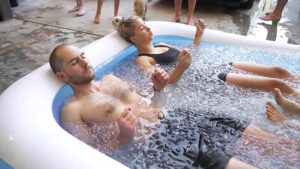
The truth is, the subjects in the study I mentioned earlier sat in cold water for an hour. I don’t know about you, but I don’t plan on taking hour-long cold showers every day. I did find several studies showing benefits even from just 20 seconds of cold exposure. However, in most cases, they used ice water baths instead of showers so the body could be fully immersed.
This doesn’t mean a 30-second cold shower does nothing. Even if your hormone increase isn’t significant by research standards, you’ll most likely still feel the benefits and a mood boost. But to feel the mental benefits long-term, there’s one more thing you need to know: it’s called adaptation. Over time, your body adapts to the cold water, and the hormonal response seems to diminish. Once you notice this, you can try making the water colder or staying in longer to continue feeling the benefits.
Does a cold shower help with weight loss?
A common theory is that exposure to cold can boost your metabolism because your body is working to heat up. This would burn more calories and thus could accelerate fat loss. What does the research say? It’s true, exposure to cold can increase your metabolism.


Most studies show cold exposure can increase your metabolism by about 15%. However, a 2021 study found that cold water immersion could increase calorie burn even more—by 50% in trained athletes. This raised their estimated daily calorie burn from 2,000 calories to 3,000! Considering that 1 pound of fat equals about 3,500 calories, theoretically, this means the subjects could burn off 1 pound of fat every three days. There are two things you should note:
Immersion time: The subjects in the study were immersed in cold water for over 3 hours! The average shower is 8 minutes, and your time under a cold shower is just a fraction of that.
Metabolic rate measurement: Researchers tested the subjects’ metabolic rate while they were in the cold water. They used this value to estimate how many calories they would burn over 24 hours. But this assumes they would continue burning calories at the same rate for the rest of the day, which is highly unrealistic.

Therefore, even if you take the data analysis extremely optimistically, it’s unlikely to ultimately produce a large enough effect for meaningful weight loss (unless you sit in cold water almost daily)—roughly an extra 5-20 calories burned per day. However, a study published just this year throws a curveball. It argues differently from what I just said and even surprised me. The subjects followed a cold protocol of five 30-second cold showers (50°F) per week and one 2-minute neck-deep cold immersion (37°F). After each cold exposure, they let their bodies warm up naturally for 10 minutes.
This means they didn’t switch to a hot shower immediately after the cold treatment but ended the whole process with cold water. After 8 weeks, the men in the study lost more than 1 cm from their waist circumference and saw a significant reduction in visceral abdominal fat—the dangerous fat stored deep around the organs. However, women experienced no significant effects. Now, while this sounds promising for men, I decided to look at this study more closely and found some serious issues.
The authors only reported the results for the “cold” experimental group. But to truly understand if the results were caused by the cold water, you need to compare them with a control group. For some reason, the researchers decided not to do this, even though they took the time to create a control group first. If you compare the two groups, you’ll find there was no significant difference between them.
Muscle Recovery and Growth After Cold Therapy
After discussing weight loss, what about muscle recovery and growth? What impact does cold exposure have? This is where things get really interesting. Ice baths have long been used as a recovery method for top athletes, and for good reason. Multiple studies show they can accelerate recovery by reducing post-workout muscle soreness, fatigue, and inflammation. This is very useful for athletes who need to recover quickly between competitions. But if you want to build muscle and strength, you’ll find that muscles are temporarily damaged and inflamed after a workout, which is part of their process of recovering and becoming bigger and stronger. An ice bath immediately after a workout can interfere with this process by reducing inflammation.
This is likely one reason why three studies now show that post-workout cold water immersion significantly reduces potential muscle growth. Therefore, if you want to maximize muscle growth and strength, definitely avoid ice baths immediately after a workout. Either do them before a workout or at least 4-6 hours after, or do them on a completely separate day. For example, I personally do these sessions on rest days and a few hours after leg days to leverage the recovery and soreness benefits without affecting my gains. As for cold showers, all the studies I mentioned used ice baths with subjects immersed for 10 to 20 minutes. Based on this, I speculate that a quick cold shower post-workout wouldn’t have any negative impact on muscle growth, and there’s no need to worry. But it’s worth noting that it also probably won’t have any meaningful positive effect on your recovery, so it might not be worth the potential downsides.